


Rare disease day: Growing larger every day.
The International Rare Disease Day celebrated its sixth anniversary this year and like every year, since its beginning on the 29th of February 2008, a rare day in itself, an ever growing number of people from around the globe joined in activities, to be a part of the annual observance aimed to raise awareness for rare diseases. This year more than 70 countries were involved in observing this special occasion making it the largest Rare Disease Day till date. New countries on board this year included Bahrain, Iceland, Israel, Palestine and Singapore. People from several countries created and uploaded remarkably informative and heart-warming videos to spread awareness about rare disease and its toll.
<center><iframe src="http://www.youtube.com/embed/VM70V7vVoF4" width="560" height="315" frameborder="0"></iframe></center>
The social media was ablaze with participation that exceeded expectations. People from all walks of life: caretakers, patient organisations, industries as well as policy makers from all over the world sent in their pictures confirming that they are all in it together to make a difference. Learn more
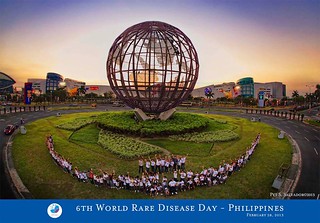 |
 |
Rare Disease Day celebrated in Algiers

Policy makers on Rare Disease Day organised by Swiss Alliance of Patients ProRaris
<center>
Show of hands for Rare Disease Day from Australia |

Show of hands for Rare Disease Day from the Committee for Orphan Medicinal Products at European Medicines Agency |
</center>

This year’s slogan “Rare Disorders without Borders” emphasises the need for international collaboration for research, treatment as well as availability of experts in the field of rare diseases, all of which remains dispersed in individual countries. This is in line with the recent global initiative taken by the European Commission and the National Institutes of Health in building and developing the International Rare Diseases Research Consortium (IRDiRC) which has already rallied the support of numerous countries. To foster international collaboration, IRDiRC has announced its first conference in Dublin Ireland on 15-17 April. This conference will bring together stakeholders in rare disease from the international arena to discern what advances can be made together. The highlights of Rare Disease Day included the symposium in Brussels organised between EURORDIS (European Organization for Rare Diseases) and the Members of the European Parliament “to examine how policy measures can help improve access to therapies for rare disease patients” (Further Details)and the setting up of radiz- Rare Disease Initiative Zurich, Clinical Research Priority Program for Rare Diseases University of Zurich- to encourage collaboration between researchers and clinicians (Further Details). This year also marks 30 years of the Orphan Drug Act and the National Organization of Rare Diseases (NORD) in the U.S., who have several activities planned through the year to commemorate this landmark.
Photo courtesy: Rare Disease Day, Eurordis, Flickr


 The meeting report for the first rare disease conference in South-Eastern Europe (SEE) held on November 15-17, 2012 can be accessed from the journal,
  A news release in an online newspaper (
 In addition to the recommendations made by the

 In a recent study published in The Lancet, the authors identified 606 patients diagnosed with congenital adrenal hyperplasia (CAH) in Sweden between 1915 and 2011, to evaluate the effects of neonatal screening in detection and care of these patients. CAH is an endocrine disorder with effects on brain and behaviour leading to sex differences wherein affected girls behave more like boys than non-affected girls. The authors found that there was “an apparent increase in the incidence of CAH during the past century, with increases in line with improvements in diagnosis and treatment over time”. Previous studies assumed that female preponderance in the salt-wasting form of this disorder is caused by missed diagnosis in girls and increased mortality among boys. However, this study showed that neonatal screening of the disease helped identify both boys and girls with salt-wasting congenital adrenal hyperplasia as they were equally missed.
 A pilot study recently published in The Journal of Maternal-Fetal & Neonatal Medicine addresses a number of issues concerning the reactions of parents of infants suffering from severe congenital heart disease (CHD). The study focuses on evaluating “emotional distress, depression and quality of life” in parents of newborns with CHD hospitalised for the first time, with emphasis on the time of diagnosis (prenatal and postnatal) and the difference of reaction of mothers from that of fathers.
  The federal court of Australia has ruled in favour of Myriad Genetics and Genetic technologies and dismissed the 2010 lawsuit to prevent the patenting of BRCA1 and BRCA2. This has been a blow for researchers and patients alike, who believe that this patenting law will impede research and genetic testing in addition to escalating costs of both. Genetics technologies had also previously demanded health services to stop testing individuals against their patented genes. The plaintiffs argued that their patent is not on the human gene itself, but on the extracted genetic material that mimics the one observed in patients susceptible to breast and ovarian cancer. They believe that the skill and expertise required to isolate it warrants a patent. An appeal for this decision has been filed in the federal court of appeals in Australia.


